Campus Evaluation of Université de Lille: Real Experiences from Students
On Google, Université de Lille has a score of 4.2 (out of 454 reviews) — data from a public platform, can be used as an initial reference. Student feedback is mixed: many praise the teaching methods and campus facilities, but others point out issues with exam schedules and catering services.
Atuhaire Christine gave a 4-star review, particularly praising the practical aspects of teaching: “To me it was an amazing touch in the education methodology that i feel was so much practical and effective that liked plus the guest lectures” (3 months ago). But she added that there were too many group assignments: “there was alot of group assisgnments that sometimes couldnt allow me develope someting of my own.” At the same time, she praised the ICT support and sports programs.
Muzamil left 5 stars: “A great and beautiful university in city of lille 🇫🇷” (9 months ago). Noel Halder also gave 5 stars and warned about language preparation: “Very good place for the students to study and Lear but mostly in French so prepare yourself if you don’t know the French language!” (5 years ago). He described the courses as “one of the best”.
Negative feedback focuses on administration. Agustín Ansorena gave 1 star, complaining about frequent changes to exam dates and limited cafeteria options: “Don’t change that many times the exam’s dates and change the menu because i have been eating only sandwiches please please” (5 months ago).
Overall, the campus environment is well-regarded, but resources for non-French instruction are limited; administrative efficiency may fluctuate. These factors can indirectly affect your housing decisions — for example, if you frequently need to study long hours at the library or lab, living closer can save commuting time; if course schedules change unexpectedly, a flexible rental contract may be more advantageous.
Lille City Background: Cost of Living and Commuting Basics
The main campus of Université de Lille is located at Cité Scientifique, 59650 Villeneuve-d’Ascq — a university town east of Lille, about 10 km from the city center. Lille is the most populous metropolitan area in northern France, with a cost of living lower than Paris but higher than mid-sized French cities.
According to local data, a student’s total monthly expenses (including accommodation, food, transport, communication) typically range from 600–1,000 EUR, with housing often accounting for 40%–50%. Lille has a well-developed metro, tram, and bus system (operated by Ilévia), and the one-way trip from Villeneuve-d’Ascq to the city center takes about 20–30 minutes. Students can apply for the Transpole transport card, with a monthly pass around 35 EUR (subsidized price varies by status; please verify before confirming).
Lille city itself also has many other higher education institutions and collaborative organizations, so there are student rental options both around Villeneuve-d’Ascq and in central Lille. If you choose to live in the city center, daily amenities are more abundant, but commuting time increases; if you choose to live near campus, it is quieter and quicker, but commercial facilities are relatively limited.
Housing Budget Range (indicative — confirm with the operator)
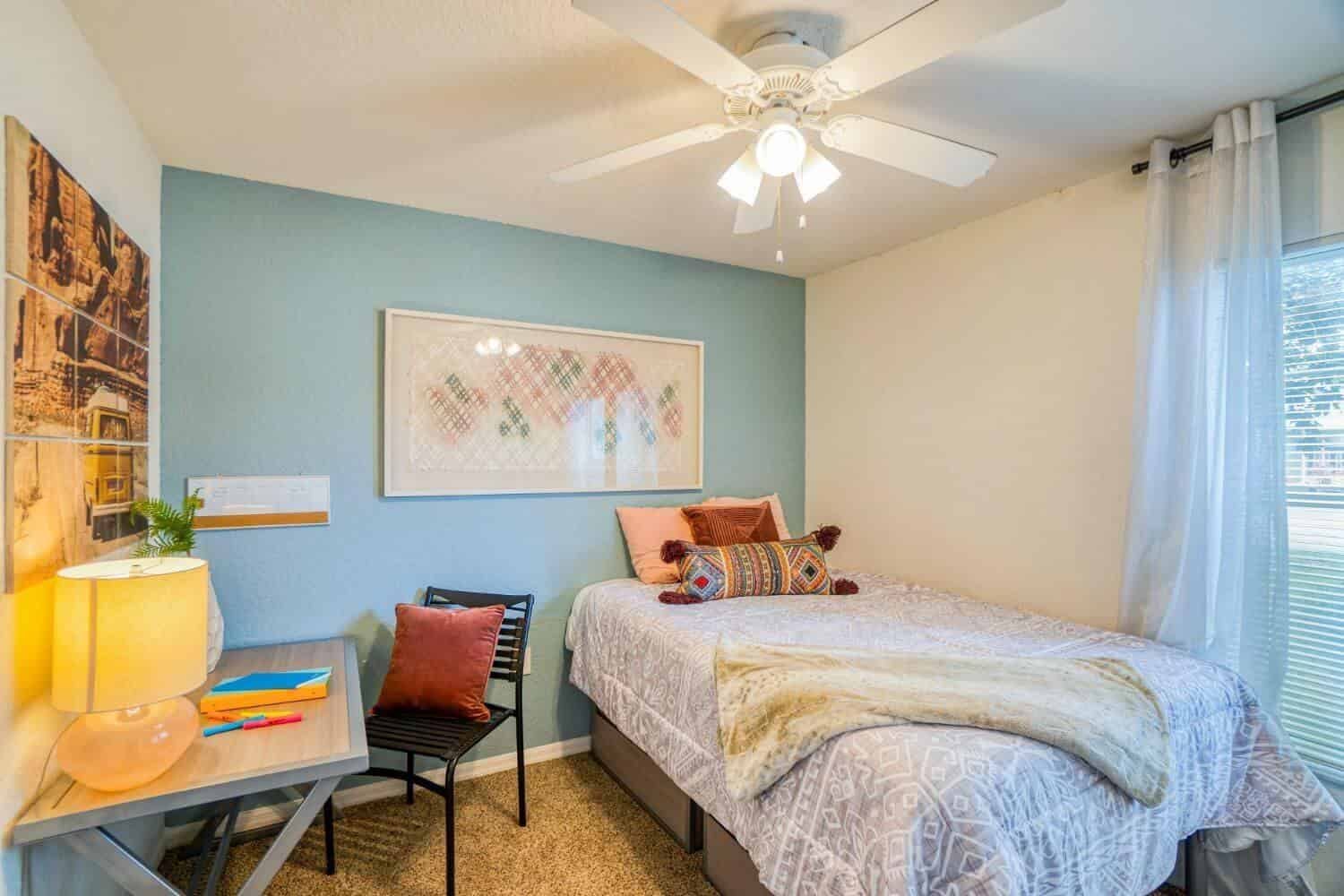
All prices below are indicative reference values; please confirm with the apartment operator or landlord.
Low Budget (350–450 EUR per month)
- Private room in a shared apartment (colocation): typically 10–15 m², with shared kitchen and bathroom. Most are located in Villeneuve-d’Ascq or Lille suburbs.
- CROUS student dormitory (e.g., Résidence universitaire): monthly rent of 150–250 EUR is typical for publicly subsidized prices, but spaces are limited and applications must be submitted a year in advance. The low budget mentioned here refers to private market shared rooms. Note: CROUS dormitories are usually prioritized for scholarship students or international exchange students; not all students can obtain them.
Medium Budget (450–650 EUR per month)
- Private student residence (résidence étudiante privée): 15–25 m² studio with private bathroom and kitchenette, usually furnished with WiFi. This price range can be found in Villeneuve-d’Ascq or central Lille (e.g., Wazemmes, Bois Blancs).
- One-bedroom apartment (T1 bis): around 30 m², monthly rent about 550–650 EUR, more suitable for students who need independent space.
Higher Budget (650–900 EUR per month)
- City center apartment (T2): 40–50 m², suitable for couples or students wanting more spacious accommodation. Located in central Lille (Lille Centre, République) or near metro stations.
- Premium student residence (e.g., private operators with gym, study rooms): monthly rent usually starts at 700 EUR.
Landlords usually require a guarantor (French or EU resident), some operators accept guarantee organizations (e.g., Visale) or payment of the full year’s rent upfront (negotiable).
Walkability vs. Public Transport Trade-offs
When choosing accommodation, the trade-off in distance to campus directly affects your time budget and study efficiency.
Walkable distance (within 1.5 km)
- Advantages: no transport costs, can sleep 15–20 minutes longer in the morning; library and lab available on-demand; suitable for research-oriented courses or exam season.
- Disadvantages: few dining and entertainment options near Villeneuve-d’Ascq campus; limited supermarkets (15–20 minute walk to a large shopping center); rent may be slightly higher (due to concentrated demand).
Public transport commute (20–40 minutes)
- Advantages: can choose accommodation in central Lille with rich amenities (restaurants, supermarkets, cultural activities); rent is usually 10%–15% lower than near campus; easier access to part-time jobs or internships.
- Disadvantages: need to buy a monthly transport pass (about 35 EUR); frequent transfers in winter can be inconvenient; if courses are spread across multiple campuses (Université de Lille has different faculties scattered around the city), commuting combinations are more complex.
Hybrid option: live within a 10-minute walk to the metro station within Villeneuve-d’Ascq, balancing quietness with occasional trips to the city. The metro stations on campus, Cité Scientifique and Villeneuve-d’Ascq – Hôtel de Ville, both connect to the city center.
How to Filter Accommodation: Shortlist Logic
The following filtering logic is based on typical student needs at Université de Lille and does not refer to any specific operator or platform. You can apply these steps to local housing search tools or site visits.
4 Key Filtering Criteria
- Commuting time: centered on the campus entrance (Cité Scientifique), calculate the one-way metro/bus time during morning peak. Prioritize routes within 30 minutes and without transfers.
- Contract flexibility: Common rental contracts in France are three years without the option to cancel freely (unless finding a replacement tenant or providing special proof), but student residences usually offer 0–12 month flexible leases. Confirm the notice period (préavis) is 1 month (furnished) or 3 months (unfurnished).
- Guarantor requirements: If you do not have a French guarantor, prioritize private apartment operators (not educational institutions) that accept Visale or bank guarantees.
- Energy and additional costs: Does the rent include heating, hot water, electricity? From 2025, the energy performance certificate (DPE) in France imposes restrictions on rents for older buildings; grades A–E are generally rentable, grades F–G may not be rentable (with some exemptions). Ask the landlord for the DPE report.
Typical Shortlist (example — for logic explanation only; properties need to be verified individually)
- Type A: Student residence within walking distance of Villeneuve-d’Ascq campus (studio, monthly rent 500–600 EUR, including internet, 11-month contract). Suitable for first-year students or those with limited French.
- Type B: Shared room in Wazemmes district in central Lille, near metro station (Lille – Hôtel de Ville) (monthly rent 400–450 EUR, utilities not included). Suitable for students who enjoy a vibrant atmosphere and are willing to commute.
- Type C: New apartment in Bois Blancs district (T1, monthly rent 650–750 EUR, furnished, accepts Visale). Suitable for students with a higher budget who want independence and proximity to campus (direct metro in 25 minutes).
Important note: Always contact the operator to confirm actual prices, availability, and contract terms. All prices above are indicative.
Frequently Asked Questions
Does Université de Lille provide official student housing? How to apply?
Université de Lille collaborates with CROUS to offer some public dormitories, but spaces are limited. Applications are submitted through the Dossier Social Étudiant (DSE) system, usually open from January to May each year. Non-French students can also apply, but success depends on nationality, academic level, scholarship status, etc. It is recommended to also prepare unsubsidized housing in the private market to avoid being without a place while waiting for results.
How to rent without a French guarantor?
Many international students face this issue. Feasible options include:
- Using Visale (a free guarantee service provided by the French government, for students under 30).
- Providing a bank guarantee (deposit the full year’s rent into a third-party account) — needs to be negotiated with the landlord.
- Choosing private apartment operators that accept full-year rent upfront (some operators require this).
- Going through an agency or student residence management company, which sometimes have their own guarantee mechanism (requires an additional fee, about 30% of one month’s rent).
Note: All options involve fees or conditions; confirm in writing before signing the contract.
Is it better for international students to live in the city center or near campus?
Depends on French language level and course intensity. If courses are entirely in French, living in the city center helps with immersive language learning; if courses are numerous and require frequent use of the library (e.g., science and engineering), living near campus saves time. A compromise is to choose accommodation along the metro line (e.g., Line 1 or Line 2), balancing both. It is recommended to register for temporary housing (e.g., short-term rental or Airbnb for 1–2 weeks) for the first semester, visit several areas in person before making a long-term decision.
Data as of March 2026. All prices are indicative — confirm with the operator before committing.
Explore more: Browse all student housing guides